
It all begins and ends with you. But we seek it with our senses. Here’s my journey so far.
I’m always late to good news. And for someone who has a habit of failing at things quite frequently, good things feel like temporary relief before the next blow.
It’s a pattern I’ve learned to accept over the years, but recently I came across the idea of the Way. And it has opened up some interesting questions that I’d like to explore with you.
This year has been exceptionally stressful, revealing instances of fund shortage, depleting clientele, and heartaches in relationships. Each of them contributed to a lack of self-worth and soon enough, self-doubt took control over my actions.
Now self-doubt has a unique feature – it puts everyone above us. Everyone is exceedingly skillful, knowledgeable, beautiful, and practical than me. Their ideas get merit by default, and their attitude is the winning type. Everyone’s great, except me.
Self doubt made me trust everyone but me. Hiring managers were messiahs, that girl who spoke to me was angelic, clients that respond were too magnanimous, and so on. Deep down I knew something was off, but when you see light at the end of an unending tunnel you run towards it, even if it’s a fast approaching train.
And so I ran, trying to catch every shiny thing that came my way. Who knows what it brings? Motivational videos and productivity tips flooded my feed, and I spent hours on Youtube searching for ways to reduce screen time.
Nothing changed. If anything, I started to believe that nothing will change. Not a great place to be, but the thought of having lost everything put me into a lull, applying for fewer relevant jobs, shying away from socializing, and always eager to apply to whatever jobs that came my way.
At Complaints’ end, I glimpse the Way.
A huge perk of being unemployed is the endless time available for reading. Stoicism, Taoism, Buddhism, Sufism, and many more isms came and went in a span of months, but I never applied it to my present moment. Instead I used them as guidelines to maintain sanity. Honestly, it worked for a while.
But no wise words have ever quelled thirst like water or hunger like food. Needless to say, words from these legends were still only suggestions at best. Everything achievable remained external. Even daily practice and productivity stayed outside my control, for joblessness had the incredible power of rendering you useless without reason.
I constantly trusted everyone, yearning for life-changing moments and funds (obviously) from anyone who could spare some. Since everyone were living better than me, surely they knew something I didn’t. They showered me with unsolicited advice, some blaming my dimwits which I agreed to earnestly, and I learned how to ‘act’ unaffected by what I was going through.
In the meantime, my debts rose to a point where menial things now became luxuries I couldn’t afford. Friends paid my bills when we went out for tea, and they took special care not to make it a big deal. I can see how they are helping me, but my inability to pay back makes me helpless at the same time.
In all this chaos, I stumbled across an old chinese novel titled ‘Journey to the West’.
It’s more than four centuries old and it’s the story that gave rise to the legendary characters in DragonBallZ. The monkey king Sun Wukong could summon a cloud to fly upon, wielded a staff that could change length as he wished, and had the reckless energy of a monkey bound to create a ruckus wherever he went.
The novel is pretty long, but what surprised me weren’t the teachings but rather a phrase that encapsulates the idea behind the lore – of Cultivating the Way.
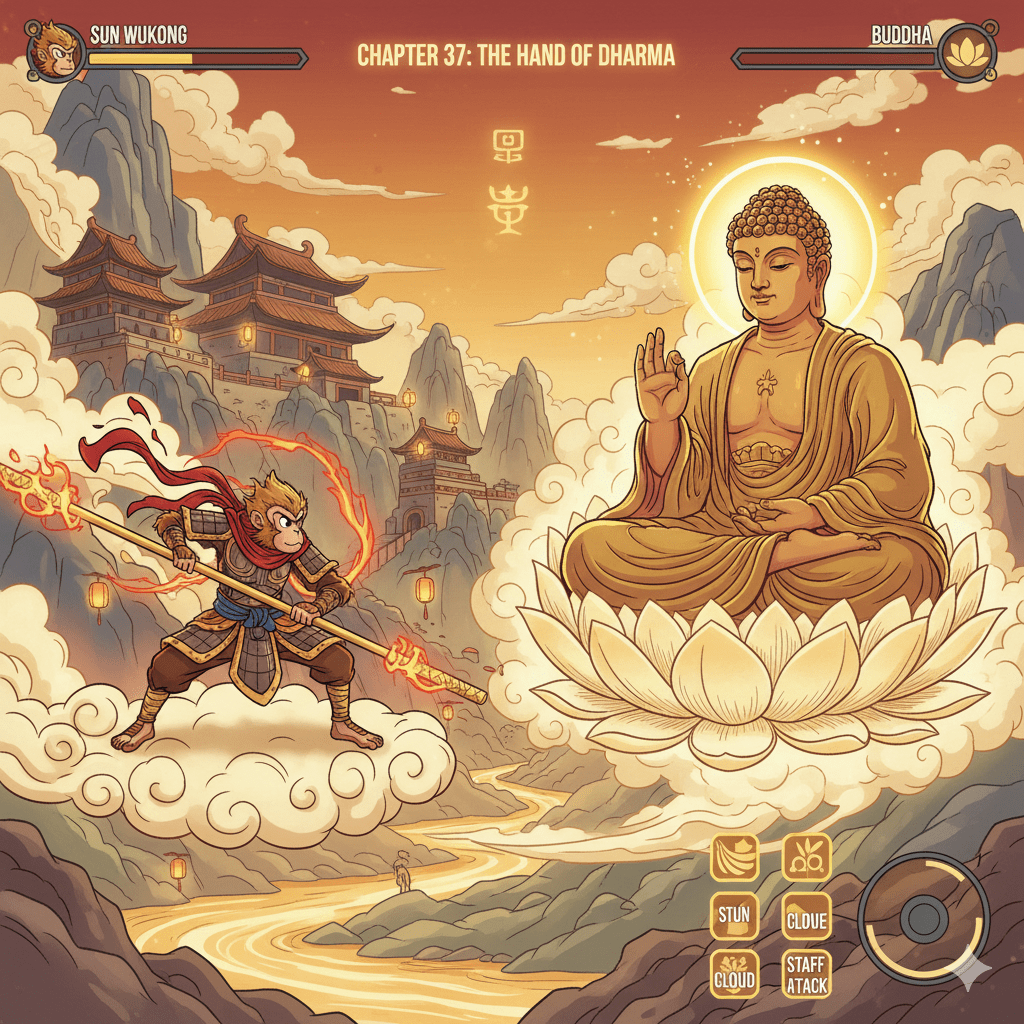
Cultivating the Way.
Every culture mentions the Way in some form or the other. The Dharma in buddhist literature, Dao in Taoism, and the whole idea of Sufism all points to a way of life that kind of feels ascetic. Abstinence and flow seems to be the overarching themes here, but I want to talk about somethng else entirely.
The ‘Cultivation’ of the Way.
Everything I have said so far requires an external validation. Clients promising future work is external validation. Buying a car to show off my colleagues is external validation. Certifications generally is external validation, for me atleast. Everything that requires another human to react favorably is external validation.
I request you to spend a moment to think of things you do for external validation.
I practiced meditation every day. It was on my daily task list including workout, and so were journaling and reading. My daily routine looked like I was doing things what every successful person might do. Still, I was miserable.
The easily trusting, gullible, and naive version of me still showed up before me, looking for opportunities to let me down whenever I skipped any of the routine tasks. It grew so vulgar to the point where if I woke up an hour late into the morning I would deem the day as lost.
LinkedIn showed me what I had to learn to be employable, Instagram showed me what I had to do to be likeable, and Youtube showed me things I need to know to stay informed. Bumble made me swipe in search of validation, which never came.
So far everything was outside of me.
But when I read the only way to immortality is through cultivating the Way, it struck a different cord inside me.
The author wasn’t talking about actual immortality or a way of living, but was hinting at a code that we must all cultivate to be undisturbed by external validation.
And mind you, it’s not ‘the’ code, but rather ‘a’ code which is unique to each of us.
The Way is within you.
The way is not a path to anywhere. It’s more like a framework we build within ourselves that guides our actions. Since we see monks and other divine people talk about it, it almost feels like it’s only purpose is enlightenment.
Sure, one can reach enlightenment by cultivating their Way, but that’s not what it is intended for.
Marcus Aurelius reminds us to ‘never yearn for the third thing’; your problem and the action to solve it are the only two things you must care about. Rewards and recognition come much later, which is of no value to the Stoic.
Dao de Ching mentions the Dao, or the Way, that we must all follow to have a balanced flow of energy. He compares it to the calm and free flow of water in a stream. But no two streams are exactly the same. So each one must have it’s own unique flow and can never be compared.
In a sense, the Way is more like a compass to which we align ourselves to, and fixing a true north is perhaps the ‘cultivation’ of it. And the components that make up the compass can be labelled as the Code.
These codes differ as much as there are people in the world. I’ll explain a code that’s helping me move away from people-pleasing.
Code – I trust contracts, not clients.
This is not because clients are inherently bad or not trustworthy. Businesses will always have different priorities and needs. I may look like a feasible solution at one time, and could be a preventable expense if their priorities change. But an agreement once written is bound to be followed, or there will be financial repercussions.
Same goes for hiring discussions. I would only trust the contract, not what anyone says during interviews. Because most often, interviews don’t reveal much about the candidate or the team in full detail. But the contract will set clear boundaries for engagement which both parties must adhere to.
Here, I focus on the actual thing of value, and not fall into trust traps of my clients. I only trust myself in these scenarios. At least from now on.

How to cultivate one’s Way.
This is an ongoing research, so my informed judgement says ‘I don’t know’.
And there is a ton of books and scriptures on cultivating one’s way. So I won’t enter Buddha’s territory of explaining it to you.
All I know is that everyone have their own little stories that guide their lives. Some past fortunes, mishaps, tragedies, victories, all guide us and shape our character. It’s a cross-section of our mortality, and each flaw can be dated back to some external event that changed us.
That’s perhaps why I love the term ‘depth of character’. Depth comes from experience and reflection, and it’s not an easy asset to come by as it requires a lot of movement and observation.
While the original Dharma or Dao asks us to follow a very strict regimen of conducting ourselves, that definition is more ritualistic in nature. What I find amusing from the stories on the Dao is that everyone is troubled by desires. We are spread across a spectrum between sainthood and a hedonism.
It requires deep reflection to identify what makes us uneasy. If you’re honest and take a liking to observe your actions in social interactions, you’ll be quick to notice a list of things you can work on.
Here are a few aspects I found troubling:
- I’m agreeable and won’t argue with anyone just to ensure peace in the room.
- I lack financial acumen and my idea of overcoming it is by throwing a lot more money at it.
- I’m afraid someone will point out my lack of technical skills and I’ll lose my job.
These are three things that just came to my mind. There are plenty of hurtful memories that guide my story, but here’s a start.
But when I free myself of validation, the above problems might shift to something like:
- I’ll listen to opinions, not to agree or disagree, but to gain a depth of understanding of both the idea and the person.
- Savings and investments are my top priorities. Luxuries can wait.
- I will graciously agree my lack of technical skills and I’ll ask for help.
One key thing here is that my code will not stop people from saying what they have to say. This is not a trick to win arguments or fights, but rather a code of conduct that constantly helps me improve. It’s more like accepting what my senses bring me, but taking action based only on my internal code.
It’s all along the Way.
For a mere mortal like me, it may take years to figure out the Way. That’s exactly why every scripture mentions the importance of the present moment. Your Way can only be cultivated now, and no matter where you are in life, your code will inevitably define your Way.
In a sense, your Way can be equated to a personal brand and your code constitutes the brand guidelines. We see rituals and recitals everywhere in honor of the gods regardless of where we are in the world. But once you understand your Way, we become much calmer and a new sense of adventure sprouts in us, one that’s no longer pointed outward, but gracefully inward and insightful.
There is nothing spiritual about this practice. Nor there should be any adoration of purity of mind and soul while cultivating your Way. Friends, challenges, and adventures will provide opportunities to kindle our Code, which ultimately shapes us into better mortals.
Some of us will eventually become immortal. If you do, please say Hi to Buddha for me.



 Binny baburaj | (Work in progress)
Leave a comment